Rule 1: Addition arithmetic with pointers
Address + Number= Address
Address - Number= Address
Address++ = Address
Address-- = Address
++Address = Address
--Address = Address
If we will add or subtract a number from an address result will also be an address.
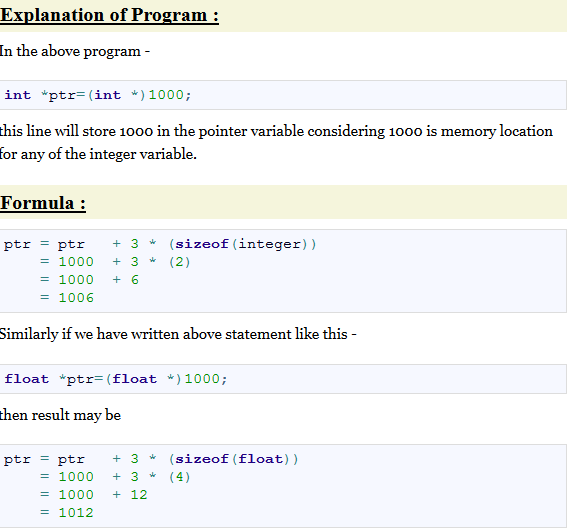
New address will be:
(1)What will be output of following c program?
#include<stdio.h>
int main(){
int *ptr=( int *)1000;
ptr=ptr+3;
printf(" %u",ptr);
return 0;
}
(2)What will be output of following c program?
#include<stdio.h>
int main(){
double *p=(double *)1000;
p=p+3;
printf(" %u",p);
return 0;
}
Output: 1024
(3)What will be output of following c program?
#include<stdio.h>
int main(){
float array[5]={1.1f,2.2f,3.3f};
float(*ptr)[5];
ptr=&array;
printf("%u",ptr);
ptr=ptr+1;
printf(" %u",ptr);
return 0;
}
Output: 1000 1020
Rule 2: Difference arithmetic with pointers
Address - Address=Number
If
you will subtract two pointers result will be a number but number will
not simple mathematical subtraction of two addresses but it follow
following rule:
If two pointers are of same type then:
Consider following example:
#include<stdio.h>
int main(){
int *p=(int *)1000;
int *temp;
temp=p;
p=p+2;
printf("%u %u\n",temp,p);
printf("difference= %d",p-temp);
return 0;
}
Output: 1000 1004
Difference= 2
Explanation:
Here two pointer p and temp are of same type and both are pointing to int data type varaible.
p-temp = (1004-1000)/sizeof(int)
=4/2
=2
(1)What will be output of following c program?
#include<stdio.h>
int main(){
float *p=(float *)1000;
float *q=(float *)2000;
printf("Difference= %d",q-p);
return 0;
}
Output: Difference= 250
Explanation:
q-p=(2000-100)/sizeof(float)
=1000/4
=250
Rule 3: Illegal arithmetic with pointers
Address + Address=Illegal
Address * Address=Illegal
Address / Address=Illegal
Address % Address=Illegal
What will be output of following c program?
#include<stdio.h>
int main(){
int i=5;
int *p=&i;
int *q=(int *)2;
printf("%d",p+q);
return 0;
}
Output: Compiler error
Rule 4: We can use relation operator and condition operator between two pointers.
a. If two pointers are near pointer it will compare only its offset address.
What will be output of following c program?
#include<stdio.h>
int main(){
int near*p=(int near*)0x0A0005555;
int near*q=(int near*)0x0A2115555;
if(p==q)
printf("Equql");
else
printf("Not equal");
return 0;
}
Output: Equal
b. If two pointers are far pointer it will compare both offset and segment address.
What will be output of following c program?
#include<stdio.h>
int main(){
int far*p=(int far*)0x0A0005555;
int far*q=(int far*)0x0A2115555;
if(p==q)
printf("Equql");
else
printf("Not equal");
return 0;
}
Output: Not equal
c.
If two pointers are huge pointer it will first normalize into the 20
bit actual physical address and compare to its physical address.
What will be output of following c program?
#include<stdio.h>
int main(){
int huge*p=(int huge*)0x0A0005555;
int huge*q=(int huge*)0x0A2113445;
if(p==q)
printf("Equql");
else
printf("Not equal");
return 0;
}
Output: Equal
Rule 5: Bit wise arithmetic with pointers
We can perform bit wise operation between two pointers like
Address & Address=Illegal
Address | Address=Illegal
Address ^ Address=Illegal
~Address=Illegal
What will be output of following c program?
#include<stdio.h>
int main(){
int i=5,j=10;
int *p=&i;
int *q=&j;
printf("%d",p|q);
return 0;
}
Output: Compiler error
Rule 6: We can find size of a pointer using sizeof operator.
What will be output of following c program?
#include<stdio.h>
int main(){
int near*far*huge* p;
printf("%d",sizeof(p));
printf(" %d",sizeof(*p));
printf(" %d",sizeof(**p));
return 0;
}
Output: 4 4 2